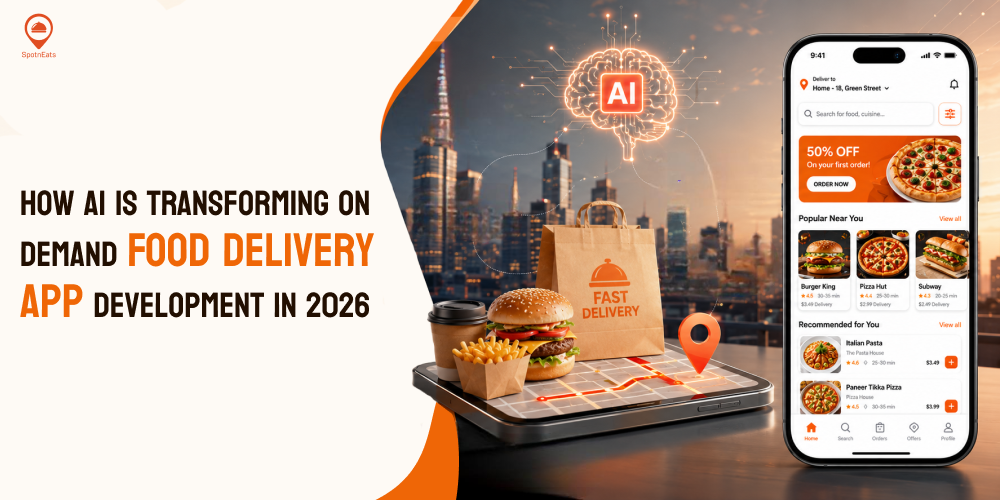
How AI Is Transforming On Demand Food Delivery App Development in 2026
AI in 2026 stands at the core of the food service industry rather than an additional solution. Food delivery startups are reinventing their existing workflows and personalizing user experience with this smart technology. Implementing AI in on demand food delivery app development benefits restaurants and food service brands through enhanced efficiency, improved customer experiences, and optimized revenue management.
AI capabilities in modern food delivery apps expand beyond order to cover automation, analytics, and delivery partner insights. Using AI in your systems in the right way will help you become a part of the thriving food industry in the USA, UK, Germany, France, or any other on-demand region. Whether you start with an ordering assistant or an AI-driven chatbot, every functionality serves a different purpose of driving your business growth.
The Role Of AI In Food Delivery App Development in 2026
Businesses consider AI a game-changer in the food delivery sector. This is because it enables them to make data-driven decisions and improve processes across the entire value chain. When old manual processes lose visibility into customers, businesses think of upgrading their processes with AI technology. And it yields restaurant owners and food delivery entrepreneurs higher profit margins within a few months of adoption.
New advancements such as AI and computer-vision-powered systems are utilized to confirm food quality and consistency while lowering operational costs. Especially conversational systems have great use in streamlining the overall ordering and payment processes in 2026. AI is working behind the scenes to deliver the following results:
- Personalized menu suggestions that match customer taste preferences.
- Resolves customer inquiries promptly and handles reservations and online orders.
- Optimizes deliveries to save fuel and cost and help increase daily delivery volumes.
Advantages Of Implementing AI in On-Demand Food Delivery App Development
AI holds immense power in developing modern food delivery apps that can optimize operations and improve convenience in ordering and delivery. Overall, the technology fits the criteria for maximizing profitability perfectly.
Enhanced Delivery Efficiency
By mapping out quicker delivery paths, AI-integrated food delivery apps help reduce wait times and increase the number of deliveries per day. Through demand prediction and geofencing technology, you can assign more delivery partners to areas with sufficient demand while limiting the possibility of leaving the zone.
Superior User Experience
Customers now just have to say what meal they want to order and place the order in seconds by confirming it. By studying user search habits, the AI tool recommends specific meals and thus helps increase order values and drive repeat customers.
Improved Retention Rates
The ability to order food in their preferred language and rewards for repeat orders drive customers to keep on ordering from the app. Location-based alerts and menu recommendations ensure that customers stay connected with your brand.
Better Stocking of items
Without clear data on what sells the most, there is an increased chance of food wastage. AI in food delivery apps predicts the demand for the day using data from market trends and users’ orders to manage inventory levels optimally.
Reduced Operational Costs
AI chatbots provide automated customer support in tracking, query resolution, and managing refunds. Thus, there isn’t much need to hire and manage a staff for the particular purpose. Smart dispatch lowers fuel costs and reduces delivery delays.
How AI-Powered Food Delivery Apps Work
AI-powered food delivery apps change the routine of ordering food, assigning delivery agents, and managing sales. Customers open the standard food delivery apps, browse the available options, check pricing, and pay for the order upon delivery. The same workflow becomes better with the infusion of AI that creates convenience in the user journeys.
1. Using Natural Language Processing (NLP), an AI-powered food delivery app converts the users’ commands into real-time booking requests and processes them.
2. An intelligent matching system checks the nearby listed drivers and analyzes their performance to connect customers with the right delivery partner.
3. Once assigned, the delivery partner uses the route optimization functionality to reach restaurants faster, receive the order, and deliver it to the customer’s pinned location within the estimated duration.
4. Restaurants predict the order volume for the day using the predictive demand engine and plan the inventory smartly.
6. The AI systems group multiple orders and assign each delivery agent to handle orders from their nearby restaurants and deliver them simultaneously. This move helps entrepreneurs make more revenue.
AI Features That Can Elevate Your Food Delivery App
AI-powered features accelerate the delivery process in on-demand app development. They also improve customer satisfaction and streamline order management. Before defining your features for a food delivery app, it is suggested that you analyze your region, what your competitors offer, and the challenges you are likely to encounter in the business.
A clear idea of these aspects will help you conclude which AI features actually add more value to your food delivery business.
Surge Pricing
AI-driven food delivery apps adjust the pricing of meals based on peak hours, weather, and festive times. The spike in the number of orders during those times is addressed by raising the prices, which helps in matching the demand and delivery partner availability. Drivers use the amount as an incentive to grow their earnings while taking more orders.
Voice Assistant
While visually appealing menus attract customers, AI takes one more step towards increasing convenience through a voice ordering system. No need to type in their order to view the preferred search result. User asks, ‘Order me a lasagna from a nearby restaurant,’ and the app displays the search results that match users’ interests and fastens the ordering process.
AI-Driven Personalization
Every modern user wishes to complete their order in limited time. What if you could develop a food delivery app that knows what customers want and suggests exactly that food? In such a case, customers spread the word about their experience, building more visibility. The suggestions are made using data on users’ past preferences and ordering behaviour.
Demand Prediction
AI in on demand food delivery app development plays a huge role in understanding demand patterns and adjusting inventory for restaurants. It helps vendors reduce food wastage and leave no chance of missing out on capturing customers who frequently order a particular meal on specific days. Hence, they can utilize resources effectively and meet demand.
Smarter Logistics
Delivery partners may not reach the restaurants and customers’ locations on time if they take routes with heavy traffic and roadblocks. Customers can get dissatisfied with the service for not receiving their order. AI algorithms detect real-time traffic and road conditions to suggest the fastest routes that help make deliveries within the estimated time of arrival.
Fraud Detection
Most customers’ payments are becoming digital, which in turn keeps the system prone to safety concerns. Moreover, restaurants are unable to verify every refund claim and process them. AI systems identify such suspicious activities and either suspend them instantly or alert the admin to help them look into the matter and resolve it on time.
Autonomous Delivery
In regions such as Los Angeles, Chicago, and Austin, sidewalk bots and other delivery robots are seen making deliveries. When implementing driverless last-mile fulfillment, food service businesses can equip the right technology to track the delivery progress and deliver the food upon reaching the customer’s location.
AI Chatbot
Answering every customer query and processing human orders promptly are possible with conversational assistants. Advanced food delivery apps open with an AI chatbot that aids in taking orders, collecting the right routes, and passing on the preferences to the restaurant. Overall, it saves food delivery businesses the cost of hiring a person to manage everything.
AI in Action: How Leading Food Delivery Apps Use AI
Popular food delivery apps across diverse countries use AI in their core systems to enhance dining experiences and elevate overall productivity.
- UberEats: The global leader uses machine learning to smartly match users with delivery partners. And it suggests the shortest routes for delivery partners to help them collect orders and make timely deliveries.
- Just Eat: From choosing meals to opting for takeaways, users of the app can get most of their ordering done using the built-in conversational assistants. In the busy world, this feature seems to impress a huge customer segment.
- DoorDash: Its smart dispatch engine batches nearby orders together, predicts the food prep times, and assigns the right delivery agent who can drop off the order at the customer’s location.
Build Your AI-Powered Food Delivery App with SpotnEats
Now you must have understood the significance of AI in on demand food delivery app development. The app provider market is crowded, creating confusion about finding the better one. With AI-powered, white-label delivery apps, SpotnEats holds a strong market presence in the field. They hire teams with technical expertise who can deliver the project on time.
Their cost-effective solutions have brought numerous brands to market faster and helped them build their brand. The company maintains transparency in its development process from discovery to design to development and launch.
Conclusion
AI is turning out to be an essential component of modern food delivery apps. Whether you consider booking or logistics, the impact of AI is visible across major segments of the systems. Single restaurants, restaurant chains, and aggregators are choosing to embed AI in their key functionalities to serve their customers effectively and improve logistics. The choice of the platform provider will make a difference in the results you can expect in the near future.
FAQ
Yes, startups can go for a ready-made AI food delivery app that can help them scale their progress through better communication, smooth logistics, and enhanced management.
Entrepreneurs require proper planning to tackle the challenges such as data privacy risks, live tracking friction, heavy set up costs, and regulatory concerns. An experienced technology provider guides you in moving past the struggles in creating AI food delivery apps
Most commonly, teams use AI technologies like predictive analytics, computer vision, automated intelligent dispatching, and Natural Language Processing (NLP) to develop food delivery apps.
Comments are closed.