
The future of the food and grocery delivery business is finding its spark in hyper-convenience, AI-infused personalization, and omni-channel integration. Businesses sustain in the high-demand yet competitive space with an Instacart clone app that features scheduled deliveries and multi-store management. Hence, the Instacart clone app is one such revolutionary invention to effectively simplify the operational performance of these ventures.
Moreover, the original Instacart software proves to remain a winning formula amidst other traditional patterns. It significantly provides a one-stop solution to all the daily needs of consumers. The custom-built app works in a specific way to innovate and optimize operations and management.
Customers can order items from nearby grocery stores using the Instacart clone app. The hyperlocal marketplace works to fulfill the needs of customers, delivery agents, grocery stores, and business owners in a unified interface. From a single store to multiple stores, the Instacart-style app takes the effort out of managing everything efficiently.
Also, the preference of this app among prominent countries is a noteworthy factor in developing a replication of the original script. This blog shows how an online grocery app makes revenue and reveals an opportunity for food and grocery firms to launch their business with an app like Instacart.
Instacart App Model: Revenue, Trends & Usage Statistics
The global statistics reveal that Instacart’s sales value tripled in recent years. The daily essentials business makes one thing clear: the strategic advantage of the Instacart clone app development for food and grocery delivery startups.
Overview:
The popularity of InstaCart seems excellent in the regions of the United States and Canada, serving over 14,000 cities, as per the company website.The Gross Transaction Volume of Instacart stood at $33.4 billion in 2024. It survived the post-pandemic loss of $1.6 billion in 2023 to a net profit of $457 million in 2024.
Economical Contribution:
Instacart contributes 20% of the online grocery delivery sector and remains a leading digital firm. Also, the food and grocery delivery through this software reaches over 10 million households. The platform accelerates growth, earnings, and food access across the US and Canadian grocery economies. Its impact is clear from the 237,000 new grocery jobs since 2012.
Revenue Growth:
Statista records that Instacart generated more than USD 850 million in revenue in its third quarter of 2024. The app made it easy to onboard and manage over 600,000 workers who deliver items from stores to customers.
Therefore, this segment has clearly given a brief overview of the statistics of the InstaCart app solution. The next segment gives an idea about what happens in the backend process of the InstaCart Clone script.
How Does The Instacart Clone App Work
The backend process of the InstaCart clone script is simplified and effective to understand and analyze. Grocery store chains can build an app like Instacart to increase the number of orders, add and manage new stores, drive more deliveries, and generate a huge revenue.
Registration Process: New users can register through email, phone number, or social media accounts. However, login credentials are often verified against the database.
Product Database: A centralized database stores product details, including names, prices, descriptions, and stock levels.
Category Management: Food menu and grocery products are organized into categories for easier browsing among consumers.
Add to Cart: Consumers can add products to their shopping cart, which updates the cart details.
Cart Management: Complete flexibility is provided to consumers to view, modify, or remove items from their cart.
Price Calculation: The backend system of the InstaCart clone app script calculates the fare total, including taxes and discounts.
Order Confirmation: Once the order is confirmed, the grocery store receives the order details in its app and starts packaging for delivery.
Automated Dispatch: The app, like Instacart, automatically assigns the delivery agent to pick up the order based on distance, reviews, and demand.
Live Order Tracking: The built-in GPS feature helps track the delivery partner’s location, order status, and the ETA.
Payment Processing: Modern customers can make secure and flexible payments in a flash with its wide range of methods, such as cards, digital wallets, and cash on delivery.
Rating System: The option enables businesses to maintain standards and ensure service quality, making changes based on the honest feedback of customers.
Data Encryption: Sensitive data of categories like restaurants, retail shop owners, delivery partners, and consumers is encrypted to ensure security.
Multi-Vendor Management: The grocery app clone lets entrepreneurs handle multiple vendors, monitor their sales, and set up pricing.
Benefits of Using the Instacart Clone App for Businesses
Startups and enterprises can capture attractive advantages with the Instacart clone app development. Also, all 4 panels, like consumer, service provider, store owner, and admin, avail all these key merits mutually.
- Lower Development Costs: Building a clone app is generally more affordable than developing a brand-new app from scratch.
- Easy Navigation: All 4 panels can effectively function with the help of InstaCart clone app easily. Also, consumers can browse products, add items to their cart, and complete purchases without hassle.
- Technological Integrations: In-built technological facilities like AI integrations help generate automated notifications to further increase the convenience.
- Proven Business Model: Following the standards of the Instacart app, using the clone version lets you avoid bottlenecks and achieve quick victories.
- Flexible Payment Methods: This app script supports various payment gateways like credit/debit cards, digital wallets, etc., to help improve secure transactions.
- Increased Revenue Potential: The convenient shopping experience and far-reaching handling help drive more sales and elevate your earning potential.
- Scalable Architecture: The app is built on a scalable system so as to accommodate any number of users, delivery partners, and vendors while matching market trends.
- Adaptable Features: The grocery delivery app, like Instacart, consists of exact features like the original script. Hence, adaptability is no longer a factor to worry about.
- Unmatched User Experience: The Instacart-style app adapts to the modern user’s needs with this stunning UI/UX design and other engaging elements.
- Review System: An impactful review option is given to consider and upgrade the app to an advanced level and attract a wider consumer base.
Revenue Models Of The Instacart Clone App
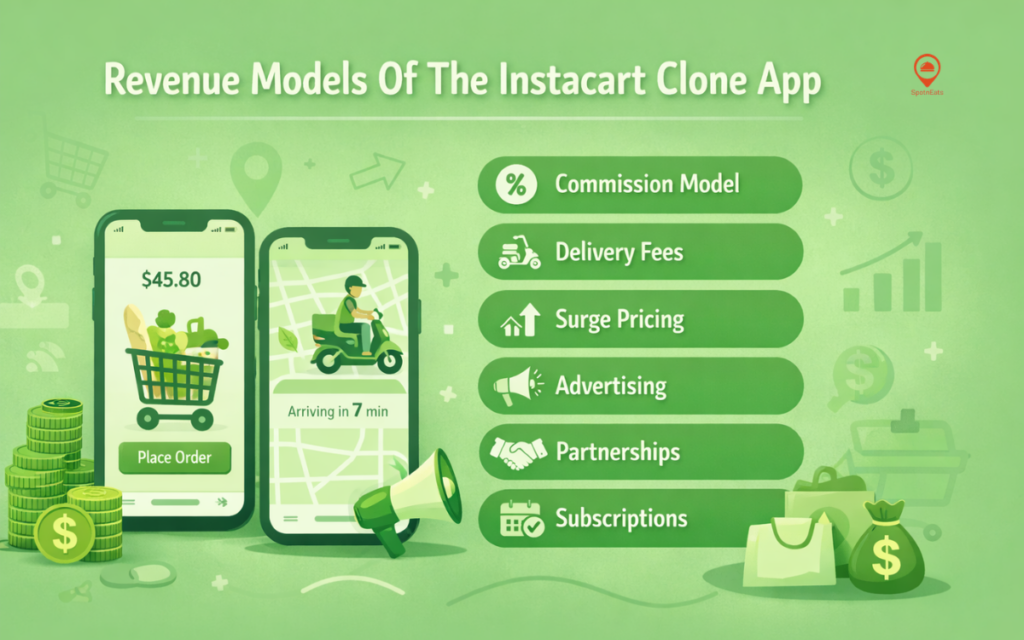
The profitable model pulls in more business owners into starting their own grocery business with the Instacart clone app. Diverse revenue streams of the app affirms grocery delivery businesses in America, and other popular regions can monetize their services in a strategic way to achieve financial stability.
Commission Model
For every order, you can set up a pricing structure to receive a certain percentage as commission. A fair pricing system will help you establish stronger relationships with local grocery stores and chains.
As a primary source of revenue, this model helps to grow your profits and plan to make more orders. You can charge a markup fee in addition to allow a vendor to list their items at a higher price.
Delivery Fees
A standard delivery fee can help support delivery agents, especially for deliveries that consume more time for travel. You can fix the delivery fees based on user convenience and boost the additional earnings.
For instance, you can charge an additional $3 based on delivery speed, peak demand, or priority delivery. Adding a flat service charge to every order to cover app maintenance and payment security.
Subscriptions
Similar to the Instacart apps, the clone model helps maintain a recurring revenue stream by offering subscriptions to customers. The predictable income stream keeps you in a stable position as you can retain more number of users.
Customers have advantages like discounts, free delivery over a certain amount, lower service fees, and priority delivery times.
Surge Pricing
During peak times, businesses may struggle to assign delivery partners to every order. You can turn this into your advantage by charging an extra amount to balance the supply and demand.
The surge pricing model can boost your earnings when there is a rush hour, special occasions, and bad weather conditions.
Advertising
In-app advertisements can serve your interests if you place relevant ads that match your services. Instead of limiting to sponsorships, you can create a combos based on user preferences and persuade them through the ads.
Sponsored listings are when vendors pay for you to highlight their store before other grocery stores in a particular region. Relevance and user search history matching are equally important.
Partnerships
Businesses can form strategic partnerships with corporations to diversify their source of revenue. You can join hands with local grocery stores to facilitate rapid deliveries and attract your customer base.
A strong delivery network is possible through partnership with shoppers or courier partners. You can maintain your delivery service quality in this way.
How to Build An App Like Instacart
Unlike the other segments, an analysis about the challenges must also be considered before proceeding with the development of InstaCart clone app.
Implementing secure transactions greatly aids to protect user data and prevents fraud.
Food delivery entrepreneurs must consider packing the food properly. This ensures a perfect feel-good experience among consumers and hence attracts more.
- Analyze the market areas to understand the actual demand for grocery and food delivery businesses. However, this factor secretly aids to effectively launch your firm.
- Choose your grocery delivery business model from inventory, aggregatory, and hybrid models based on your resources and goals.
- Grocery store owners must perfectly provide a clear list of products with details to avoid unwanted confusions.
- Plan your tech stack to match the modern user needs, which commonly requires React Native, PHP, PostgreSQL, GraphQL, MongoDB, and Golang.
- Understand the Instacart clone app development cost, define your requirements and invest accordingly.
- Build a strong delivery network to ensure that automated dispatch occurs seamlessly.
- Launch your grocery delivery service locally, observe the results, and expand your reach to global.
Launch Your Own Instacart Clone
While you have everything prepared, you are at the stage to pick the right partner who can deliver a custom app like Instacart.The perfect firm to initiate your launch is none other than SpotnEats. We help build your food and grocery delivery venture dream with utmost innovation and creativity.
Also, the implementation of advanced code and technology is the greatest step toward success. We score well on complete customization, scalable technology, and dedicated support. As an entrepreneur, you can invest the entire time and revenue into us for achieving undeniable achievement. Our grocery delivery app script suits every grocery business model and is known to cater to business’s needs accurately.
FAQ
An Instacart clone app enhances the user experience by providing a user-friendly interface, personalized recommendations, and a seamless checkout process. Features like real-time tracking and multiple payment options further improve customer satisfaction.
Businesses can benefit from lower development costs, faster time to market, and the ability to customize features to meet specific market needs. Additionally, the app can help businesses tap into the growing online grocery market.
The cost of building an Instacart clone app varies based on app complexity that comprise features, customizations, technology used, integrations, and more. Developing a grocery delivery app like Instacart can cost anywhere between $60,000 to $150,000.
AI advancements, smart device integrations, and sustainable initiatives shape the future of grocery delivery apps. Businesses are learning to adapt to the trends to create a safe spot for their growth.
Yes, the Instacart clone app is scalable and can help you run any number of grocery stores and accommodate the expanding users and delivery partners.