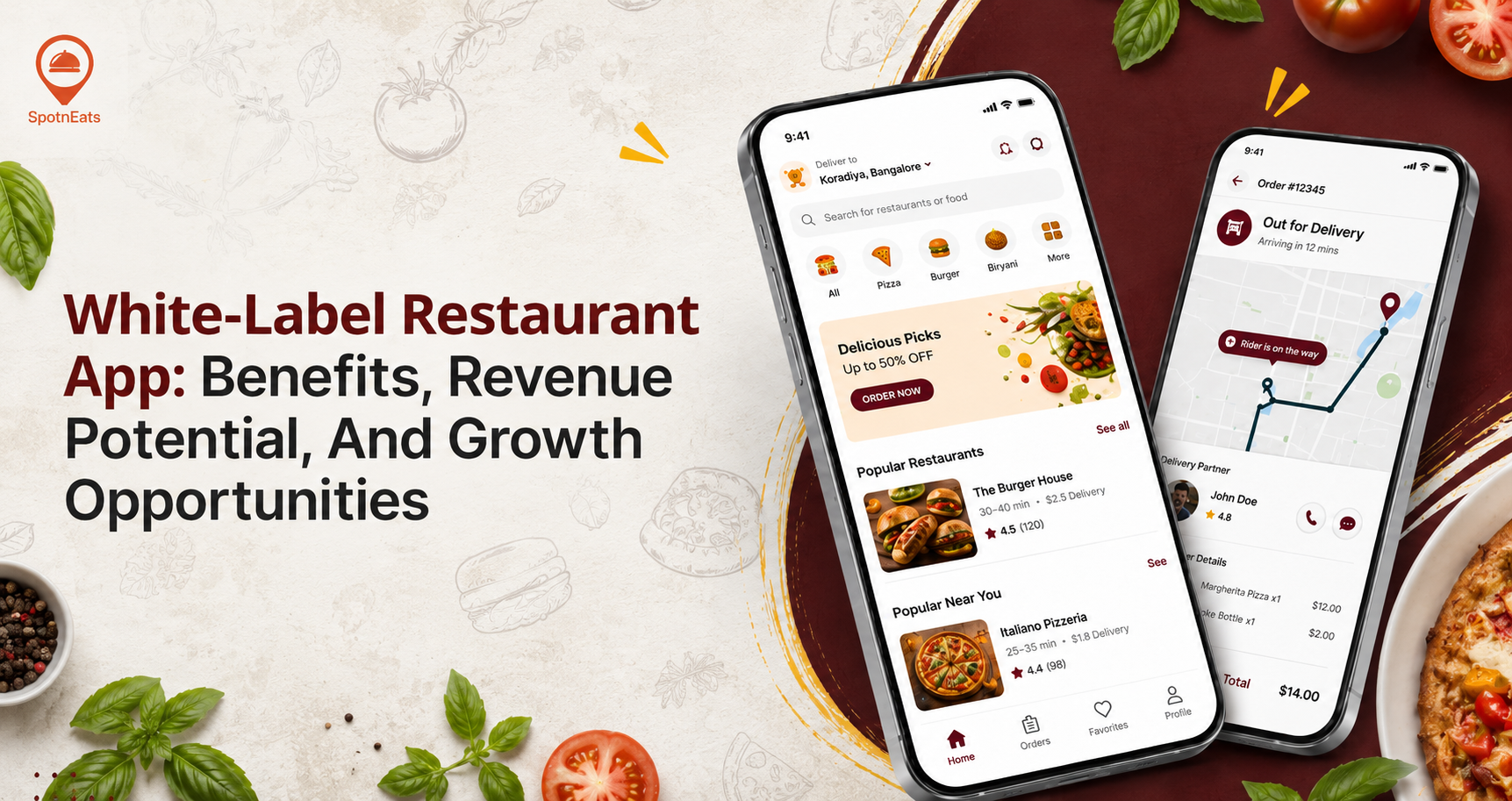
White Label Restaurant App: Benefits, Revenue Potential, and Growth Opportunities
If it’s your first time launching an app for restaurants, you are likely to be skeptical about the overall process, the type of app you need, and the provider. The same old strategies of restaurants have lagged behind in accommodating user requests. The current dynamic environment expects you to deliver a personalized customer experience that encourages customers to keep returning to your outlet or continue ordering from your physical location. And food delivery aggregators like DoorDash and Grubhub take up to 15-30% per order. So, a noticeable shift towards a white label restaurant app is apparent to own customer data and keep 100% of the sales.
Considered a better investment, let’s discuss how the ready-to-use app transforms online ordering and simplifies the guest journey. The key to success is white label technology, from which restaurant partners can cut operational costs and boost their revenue. Wouldn’t you want to know whether it’s a smart investment that can help your restaurant stand out today? That’s exactly why we’ve created this helpful blog.
What Is the Concept of a White-Label Restaurant App?
A white label restaurant app is a mobile app for restaurants to rebrand it under their name, color, menu, and pricing system. Restaurants can use the native app to connect with their customers and get more sales of food without the need for in-house designers, developers, and testers to launch the branded app. The white label app provider creates the technology and transfers the rights to the restaurant for rebranding purposes. Thus, the restaurant owner can utilize the digital tool to enhance their brand presence and manage orders, update menu and pricing, monitor performance, and track deliveries from the seamless ecosystem.
Restaurants can serve their customers with the white label solutions because of their flexible ordering, visually rich menus, quick reordering, push notifications, and inventory control. With the booking engine, you can establish a strong relationship with customers and get complete control at your fingertips.
In simple words, what is so special about white label restaurant app?
- Reflects the brand’s identity
- Direct connection with customers
- Supports targeted marketing
- Wide integrations options
- Keep a whole percentage
Major Differences Between White-Label & Third-Party Aggregator Solutions
When restaurants believe they need their own app, what strikes their mind at first? It is about whether to go with an app that already has a massive user base and delivery logistics or create their own restaurant app. Since we are giving a thought into only cost-effective solutions, we rule out custom restaurant apps. Drawing on our strong relationships with clients, we’ve identified the key differences and compiled them for you below:
1. A ready-made software fee applies for launching the white label restaurant app, while registering on the aggregator platform does not usually carry a charge.
2. The aggregator platform receives a heavy commission of up to 15% on every order, along with delivery fees and charges for featured listing. The white label restaurant app allows you to keep the whole sales amount while managing payment processing fees.
3. There is less scope for establishing your brand recognition since you are one among the hundreds of listed restaurants on the third-party aggregator platform. The white-label solution gives you room to customize the app with loyalty programs, push notifications, and direct promotions without having to compete for visibility on the same screen.
4. Exposure to local users is quick with the third-party aggregator platform as it handles its own marketing campaign. With the white label solution, the responsibility of driving traffic falls into your hands.
Benefits of Developing A White-Label Restaurant App
Independent restaurants, restaurant chains, and food delivery entrepreneurs are continuously investing in a white label restaurant app. Learning more about its advantages helps you focus on the right factors and see a rise in profit margins in the heavily crowded yet profitable market.
Meet The Rising Customer Expectations
Restaurant-specific mobile apps are becoming an essential part of modern customers’ dining journey. Customers no longer prefer driving to restaurants, using drive-throughs, or waiting at counters to get their meals. Contactless deliveries, voice-based booking, and personalized food suggestions drive customers to keep ordering from their favorite restaurants. Launching a mobile app that can do all this is a strategic growth tool that accommodates modern customer needs, making it easier to order and enjoy meals from restaurants.
Frictionless ordering, personalized notifications, customized loyalty programs, and POS integrations help cater to customer preferences.
Own Customer Data for Better Strategies
Most restaurants lose customers not because of the food they serve, but because they fail to act on real-time customer feedback. The challenging part is collecting feedback from each customer in person, analyzing it with a dedicated staff, and improving services in order to increase sales. When you develop your own restaurant app, you get absolute control over your customer data and analytics. Restaurants can track order history and discover favorite menu items to optimize strategies for better engagement.
Using the customer data, business owners can segment their audience into groups based on behaviour to send targeted marketing messages.
Maintain A Strong Brand Identity
A strong brand image is essential for restaurants looking to expand their customer base. Without a loyal following, restaurants risk losing customers who have previously ordered and enjoyed their food. A personalized digital presence helps restaurants maintain their brand identity while making it easier for customers to interact with the platform. With a white-label solution, restaurants can ensure a consistent experience across their mobile app and website, helping them stay ahead of the competition and strengthen their brand presence.
Restaurants can move beyond generic ordering tools to a scalable app that acts as an extension of their brand, driving repeat orders and building lasting loyalty.
Elevate Your Potential To Earn Revenue
The white label app for restaurants eliminates the need to pay high commissions to third-party marketplaces and helps you find new direct revenue streams. Restaurants can collect a small fixed service fee from customers to cover first-party delivery and service charges. Diners pay a monthly fee to subscribe to your platform for free delivery and exclusive discounts. After gaining a certain number of customers, you can post relevant ads on the app to earn extra while continuing to engage customers with your service.
The digital platform helps you build stronger customer relationships, drive repeat visits, and increase sales through effective revenue management.
Dedicate Resources to Grow Business
White-label solutions seamlessly integrate with existing systems such as POS, payment gateways, and other APIs. These platforms help restaurant businesses reduce errors and deliver a seamless ordering experience for customers. The solutions become a cohesive extension of your brand, creating a consistent and trustworthy experience. With greater control over the customer ordering process, restaurants can strengthen engagement and loyalty.
Ultimately, this creates a smoother customer journey while supporting operational efficiency and business growth.
Core Features to Integrate Into a White-Label Restaurant App
Not every white-label platform is built the same, and the feature set you choose determines whether your app becomes a genuine growth engine or just a digital menu card. Based on what leading providers are shipping in 2026, here are the features that deserve a spot on your must-have list:
Branded Native Apps & PWA Support
Customers should feel like they’re interacting with your restaurant, not a rebranded template. A modern white-label platform should offer fully branded native apps for iOS and Android, along with progressive web apps that perform consistently across devices, so no diner is left out because of the device they’re carrying.
Real-Time Order Tracking & Driver Assignment
Diners expect to watch their order move from the kitchen to their doorstep. Live status updates, estimated delivery windows, and automated driver dispatch keep customers reassured and reduce the volume of “where’s my order” calls to your staff.
Menu & POS Synchronization
Your online menu should never fall out of step with what’s actually available in the kitchen. Menu management that stays synced with your POS keeps pricing, availability, and modifiers accurate across every ordering channel, cutting down on cancelled orders and customer frustration.
Push Notifications & Personalized Promotions
Timed offers, abandoned-cart reminders, and personalized recommendations based on past orders keep your restaurant top of mind without relying on paid ads.
Loyalty Programs & Rewards
Points, tiered discounts, and free-item rewards turn one-time diners into regulars. Since you own the data, you can design a loyalty structure that reflects your actual margins instead of a generic template.
Secure In-App Payments
Saved cards, multiple payment gateways, and one-tap checkout reduce friction at the exact moment a customer is deciding whether to complete an order.
Delivery Management & Logistics Integration
Whether you run your own delivery fleet or plug into third-party driver networks, your app should give you a single dashboard to manage dispatch, routing, and delivery performance.
Analytics & Admin Dashboard
A clear view of your best-selling items, peak order hours, repeat customer rate, and campaign performance turns your app from an ordering tool into a decision-making tool.
Multi-Location Support
For restaurants with more than one outlet or a catering arm, look for a platform that lets you manage multiple locations, sell gift cards, and handle bulk or scheduled orders from the same system.
The payoff for getting this right is measurable. Restaurant app users tend to order more frequently than customers who only order through a website, which makes a well-built feature set less of a cost center and more of a direct driver of repeat revenue.
What to Consider When Choosing A Provider for a White-Label Restaurant App
With dozens of white-label providers competing for your attention, the real differentiators sit beneath the marketing pages. Here’s what actually deserves your evaluation checklist:
Pricing Model
Providers structure their fees differently, some charge a one-time license fee, others run on monthly subscriptions, and a few still take a small commission per order. Map the pricing model against your order volume and margins before committing, since a model that works for a single outlet may not scale to a multi-location chain.
Source Code & Data Ownership
Ask upfront whether you get full source code access or a locked-in license. Providers vary considerably here, and the difference affects how much control you’ll have over customizations, third-party integrations, and long-term flexibility if you ever want to switch vendors.
Customization Depth
A provider that only lets you swap a logo and color scheme isn’t offering much more than an aggregator listing. Look for platforms that let you customize the ordering flow, layout, loyalty structure, and promotional tools to match how your brand actually operates.
Integration Ecosystem
Your app needs to talk to your existing POS, payment gateway, and delivery network without manual workarounds. Confirm the provider supports the specific systems you already use, rather than assuming compatibility.
Scalability & Performance
Whether you’re launching a single outlet or planning to expand across multiple cities, the underlying infrastructure needs to handle order spikes and growing traffic without slowdowns. Ask about performance under peak load, not just standard demos.
Time to Launch
Depending on complexity, most white-label builds take anywhere from two to four months from kickoff to launch. If a provider promises a significantly faster timeline, dig into what’s being cut to get there.
Support & Maintenance
Bug fixes, security updates, and app store compliance shouldn’t fall on your shoulders. Confirm what’s included in ongoing support versus what counts as a billable add-on.
Taking the time to compare providers against these factors is what separates restaurants that see a real return from their app investment from those that end up re-platforming within a year.
Launch Your Own Branded Restaurant App With SpotnEats
SpotnEats brings together everything discussed above into one ready-to-deploy white-label solution built specifically for cloud kitchens, restaurants, and multi-outlet chains. From fully branded native apps to real-time order tracking, POS-synced menus, loyalty programs, and a centralized analytics dashboard, SpotnEats gives you the complete toolkit to own your customer relationships instead of renting them from an aggregator.
Our team handles the heavy lifting, be it development, testing, deployment, and ongoing maintenance. So, you can focus on running your restaurant while we keep your app running smoothly in the background. Whether you’re launching your first branded app or replacing a costly third-party listing, SpotnEats gets you to market without the overhead of building from scratch.
Ready to keep 100% of your sales and build a direct relationship with every customer who orders from you? Get in touch with our team to see how a SpotnEats-powered app can fit your restaurant’s growth plans.
Final Thoughts
The shift away from aggregator dependency isn’t a passing trend; it’s a response to restaurants wanting back what third-party platforms have quietly taken over the years: their customer data, their margins, and their brand identity. A white-label restaurant app hands all three back to you, without the time and cost of building custom technology from the ground up.
The providers and features will keep evolving, but the core decision stays the same: do you want to keep renting your customer relationships, or start owning them? For most restaurants weighing the math on commissions, repeat orders, and long-term brand equity, a white-label app is turning out to be the more sustainable answer.
FAQ
No. Unlike aggregator platforms that take a cut of every order, a white-label app lets you keep the full sale amount, minus standard payment processing fees.
Most established white-label providers, including SpotnEats, support integration with popular POS and payment systems so your menu, pricing, and order flow stay in sync across channels.
Yes, even single-location restaurants benefit from owning their customer data, cutting aggregator commissions, and building direct loyalty programs. The investment tends to pay off faster than most owners expect, especially with repeat customers ordering more frequently through a dedicated app.
Comments are closed.